Most owners start asking this question the month the books close three weeks late, or the night they catch themselves reconciling bank accounts at 10 p.m. Some notice it when the monthly reports arrive and nobody quite trusts them. The first instinct is to post a job for an accountant. Look at the price before you do. Once you add benefits to the median salary, one accountant costs roughly $119,000 a year, and that buys you one person's bandwidth.
For most growing businesses, an outsourced team, including providers offering the top virtual outsourced finance and accounting services online, is the better first step. A full-time hire earns its keep later, when daily on-site work and transaction volume can keep one person busy all year. Until then, accounting needs an owner with a plan, not a spare hour on someone's calendar.
We lean toward outsourcing first, and we'll say plainly when hiring is the better call.
TL;DR Quick Answers
Top virtual outsourced finance and accounting services online
The top virtual outsourced finance and accounting services give you a full accounting team for less than the cost of one in-house hire, and they go well beyond bookkeeping. Bookkeeping tells you where your money went. A strong outsourced accounting team shows you what it means and helps you plan.
What the best providers deliver:
A documented month-end close. Your books close on the same schedule every month.
Reporting leadership can be read. Custom reports and dashboards track trends and performance, not just transactions.
Internal controls. Approval workflows for payables and receivables cut risk and keep records audit-ready.
A team instead of one person. Specialists share the work, so nothing stalls when someone is out.
Your existing tools. The provider works inside cloud platforms like QuickBooks Online and connects the payroll and payment apps you already use.
Clear pricing. The provider scopes the fee to your transaction volume and puts it in writing before you sign.
Quick check before you choose: if a provider only records transactions, you're buying bookkeeping, not outsourced accounting.
Top Takeaways
A full-time accountant costs roughly $119,000 a year once you add benefits to the $81,680 median salary.
Outsourcing trades one person's skill set for a team, so your finances don't stall when someone leaves.
Hire when you need daily on-site help and have the volume to keep one person busy.
Many growing businesses end up with a hybrid: an in-house admin for daily tasks, and an outsourced team for the close and reporting.
Outsourcing first shows you what a future hire would actually need to do.
Hiring an Accountant vs. Outsourcing Accounting: What Actually Changes
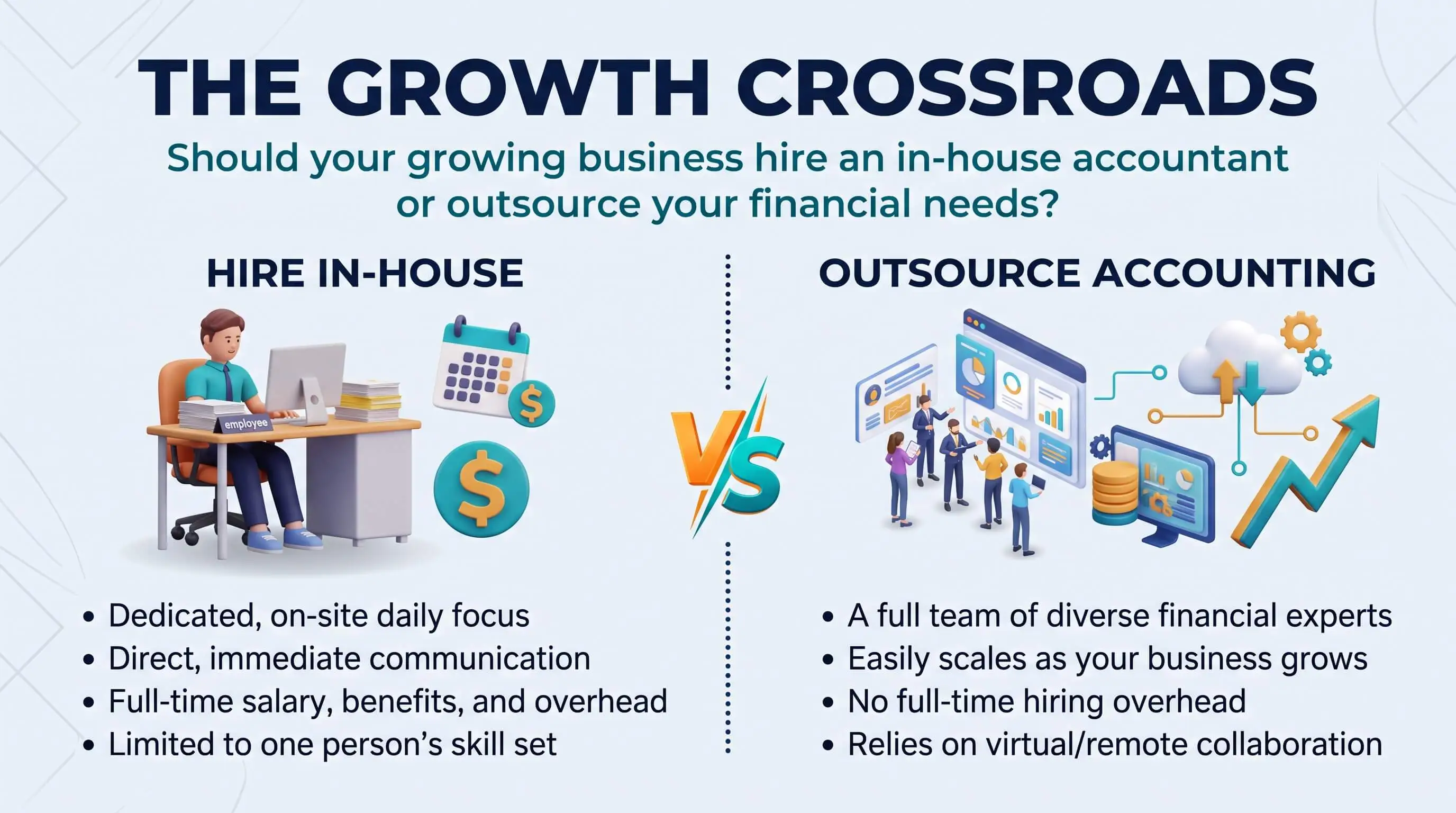
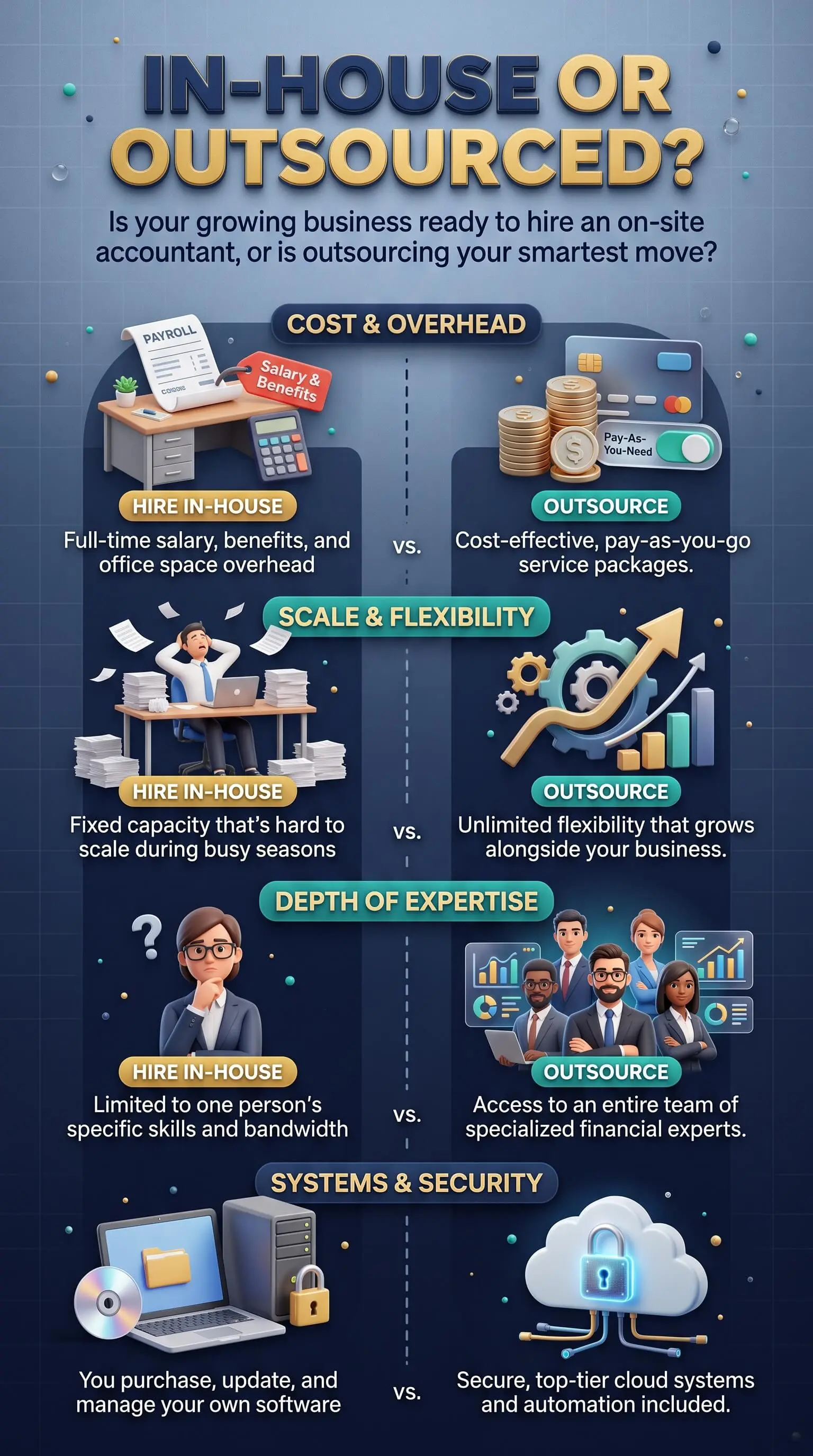
Coverage is the biggest difference. Hire one accountant and you get one person's time and one skill set. Outsource, and a team of specialists splits the work, with backup when someone's out. Plenty of owners have already made a version of this call when weighing an in-house team versus an outside agency for marketing.
What You Get With an In-House Accountant
An in-house accountant sits down the hall. They learn how your business runs day to day and work inside the processes you set. Most questions get answered in five minutes. If someone needs to handle cash or sign checks every day, that proximity is worth paying for.
Range is the limit. Few people are equally strong at transaction work, the month-end close, reporting, and internal controls. And when your accountant calls in sick or gives notice, the work waits.
What Outsourced Accounting Covers
Outsourced accounting means an external team runs your financial operations, so you get a finance department without building one. A typical scope includes transaction management, reconciliations, accounts payable and receivable, payroll posting, the month-end close, performance reporting, budgeting, and internal controls. A good provider works inside the tools you already use instead of making you switch.
It helps to picture a ladder:
Bookkeeping records transactions and keeps the books tax-ready.
Outsourced accounting adds a full close, controls, and reports that explain what the numbers mean.
A fractional CFO takes those numbers and plans cash, pricing, and growth.
Most growing businesses feel the gap on the middle rung first. So when you compare the top virtual outsourced finance and accounting services online, look hard at how each one handles the close and the reporting, not just data entry.
What Each Option Costs
The salary on an offer letter is only part of what a hire costs.
Base pay. Accountants and auditors earned a median of $81,680 a year in May 2024, according to the Bureau of Labor Statistics. Outsourced accounting has no salary. Firms price it by scope and transaction volume.
Benefits and payroll taxes. In June 2026, benefits made up 31.5% of what private employers spent on full-time workers. An outsourced fee already covers that.
Total cost. Add it up and a hire comes to roughly $119,000 a year, before recruiting and training. Outsourced engagements usually cost a fraction of that, and some firms start around $350 a week [VERIFY].
Coverage. A hire is one person. A team has backup built in.
Time to start. Recruiting can take months, while onboarding an outsourced team often takes a few weeks.
The $119,000 figure comes from simple math. Wages make up 68.5% of what an employer spends on a full-time worker, so an $81,680 salary works out to about $119,000 in total compensation.
Signals That Point to Hiring, Outsourcing, or Both
Your situation matters more than any rule of thumb. These are the signals we see come up again and again.
Your books close weeks late, and the numbers don't match across systems. Lean toward outsourcing.
Leadership wants dashboards and trends, and all you have is records. An outsourced team closes that gap faster.
Someone has to be on-site every day to handle cash, checks, or deliveries. That's a case for hiring.
You have enough transaction volume to keep one person busy all year. Hiring starts to make sense.
An audit, a lender review, or an investor conversation is coming up. Outsource, or pair any hire with outside oversight.
One employee holds everything about your finances in their head. Outsourcing removes that single point of failure.
The Hybrid Path Most Growing Businesses Land On
You don't have to pick one model forever. For diverse ethnic marketing agencies managing multiple clients, campaigns, vendors, and project expenses, a setup we see work well keeps an admin or operations person in-house for receipts, approvals, and vendor questions, while the outsourced team owns the month-end close and the controls around it. When the business can support a controller, that person walks into organized books instead of a cleanup job.
Why Project-Based Businesses Feel This First
Agencies and service firms live on retainers, milestone billing, and contractor payments, so cash comes in lumps. When client payment timing doesn't line up with payroll, a dependable monthly close is how you find out which clients and projects turn a profit. There's more on that side of things in how outsourced accounting supports agency growth.
"Owners almost never tell us the salary was the problem. What catches them off guard is how much they depend on one person. We've come into companies the week after their only bookkeeper left, and nobody could say what was owed or what had come in. We fixed it with a documented close and a monthly report the owners could actually read. After that, the hiring question got a lot easier, because they could see which work needed someone in the building and which never did."
7 Essential Resources
These are worth a look before you post a job or sign an engagement letter.
The SBA's guide to managing business finances walks through balance sheets, cash versus accrual accounting, and when to bring in a CPA or bookkeeper.
Whoever does your accounting has to meet the IRS rules in Recordkeeping for Businesses.
If you plan to hire, Employment Tax Recordkeeping lists the payroll records you'll need to keep for at least four years.
The IRS Small Businesses and Self-Employed hub collects filing, deduction, and employer guidance in one place.
Check current pay and job outlook for the role in the BLS profile of Accountants and Auditors.
Centri Consulting's comparison of in-house and outsourced accounting gives a fair hearing to what in-house staff does well.
CFO Brew reports that demand for accounting grads still outstrips supply, which helps explain long hiring searches.
These resources can help you compare hiring with outsourcing, understand recordkeeping and payroll requirements, and evaluate the best remote outsourced QuickBooks bookkeeping services before choosing how to manage your business finances.
3 Statistics
$81,680 was the median annual wage for accountants and auditors in May 2024, according to the Bureau of Labor Statistics. That's the midpoint. Experienced candidates in competitive markets cost more.
31.5% of what private employers spent on full-time workers in June 2026 went to benefits, per the BLS Employer Costs for Employee Compensation report. So a salaried hire costs noticeably more than the offer letter suggests.
7.8% fewer students earned bachelor's degrees in accounting in the 2021 to 2022 school year, leaving about 47,000 graduates. The Journal of Accountancy reported the drop from the AICPA's Trends report. A thinner talent pool is one reason a search for a qualified accountant can drag on for months.
Final Thoughts and Opinion
Outsource the accounting function first, then hire into whatever gaps it shows you. That's our recommendation for most growing businesses, and we'd make it again.
The mistake we see most is owners trying to answer the hiring question before they understand the work. They don't know how many hours the close takes, which reports leadership opens each month, or where the controls are thin. Hiring into that uncertainty usually means paying for the wrong skill set, or asking one person to cover four jobs.
An outsourced team puts structure in place quickly. A few months in, you'll know which tasks need someone on-site and which never did. If you later bring in a controller, they start with clean books and documented processes.
Some businesses should hire now. If you handle cash every day, or your volume already fills a full-time role, a hire makes sense. Just pair that person with outside oversight so everything doesn't depend on them. Clear, current numbers also make it much easier to protect margins as you grow.
Frequently Asked Questions
How much does it cost to hire an accountant compared with outsourcing?
Expect roughly $119,000 a year for a full-time accountant once you include benefits, based on the BLS median salary of $81,680. Recruiting, software, and training come on top of that. Firms price outsourced accounting by scope and transaction volume, and for most growing businesses it costs a fraction of a hire.
Is outsourced accounting the same as bookkeeping?
No. Bookkeeping records your transactions and keeps the books accurate and tax-ready. Outsourced accounting builds on that with a full month-end close, internal controls, reporting, and budgeting. Bookkeeping tells you where your money went. Outsourced accounting helps you understand what that means and plan for what's next.
When should a small business hire an in-house accountant?
Hire when someone needs to be on-site every day for cash, checks, or approvals, and your transaction volume can keep one person busy full-time. A controller-level hire also makes sense once your books and processes are organized enough to hand over.
Can I outsource accounting and still keep someone in-house?
Yes, and it's one of the most common setups we see. An admin or operations person handles receipts, approvals, and vendor questions on-site. The outsourced team takes the close, reconciliations, reporting, and controls. You get daily presence plus specialized oversight without paying two full-time salaries.
How long does it take to switch to outsourced accounting?
Most providers can fully onboard a business in about a month. The timeline depends on how clean your current books are and how many systems need to connect, like payroll, payment processors, and bank accounts. A good provider plans the handoff so your financial oversight never lapses.
What should I look for in the top virtual outsourced finance and accounting services online?
Start with scope. The provider should go beyond bookkeeping into a documented close and reporting your leadership team can actually read. Ask who your point of contact is, how they secure your data, and which platforms they support. The provider should tailor pricing to your volume and spell it out before you sign.
Weigh Your Options With a Clear Picture
Before you write a job post, try this. List every accounting task your business handles in a month and roughly how long each one takes. Then hold that list up against a scoped quote from an outsourced accounting firm for eCommerce startups. Most owners can tell pretty quickly whether they need someone in the building, a team behind them, or a bit of both. No sales pitch required, just a clearer view of your numbers.
Already made this call for your own business? Tell us what worked in the comments.