Bilingual SEO is not translation. It is the strategic discipline of ranking in two languages, connecting with two distinct cultural mindsets, and earning trust in two entirely different search landscapes — simultaneously. Most businesses understand this in theory. Far fewer find the multicultural agency that can actually execute it.
The difference between a multicultural agency that understands bilingual SEO and one that merely claims to is not always visible on a proposal. It shows up in your rankings, your organic traffic, and ultimately, your revenue — or the absence of all three. From years of working at the intersection of cultural strategy and digital marketing, the patterns are clear: bilingual SEO done wrong is one of the most expensive mistakes a brand can make. Bilingual SEO done right is one of the most powerful competitive advantages available in today’s market.
This guide breaks down exactly what separates the top multicultural marketing agencies from the rest when it comes to bilingual SEO — including what to look for, what red flags to avoid, and what success actually looks like when a qualified agency is executing on your behalf.
TL;DR Quick Answers
Top Multicultural Marketing Agencies
Top multicultural marketing agencies are full-service firms that build authentic connections between brands and diverse consumer audiences — combining cultural fluency, bilingual strategy, and data-driven campaign execution across Hispanic, Black, Asian, and other multicultural markets.
What separates the best from the rest:
Cultural authenticity first — they bring lived cultural experience to strategy, not demographic assumptions
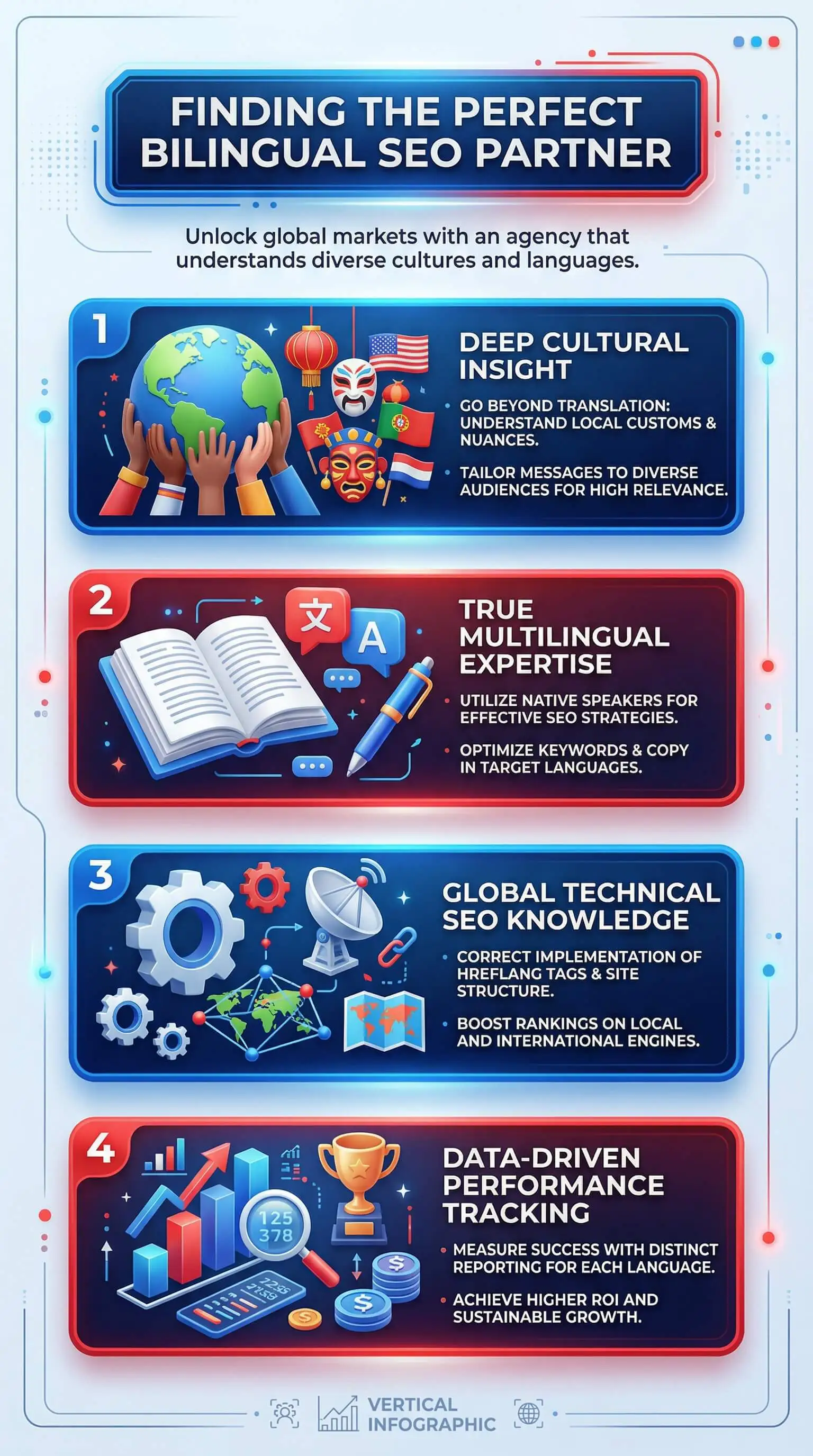
Bilingual SEO capability — native-language keyword research, hreflang implementation, and dual-language performance reporting
Diverse talent on staff — native-speaking strategists, creatives, and account leads across target communities
Proven multicultural results — verifiable SERP rankings, campaign performance, and brand trust metrics in both languages
Full-service reach — covering paid media, organic search, public relations, social media, influencer partnerships, and brand consulting
The top agencies do not translate general marketing into multicultural. They build from the inside of the culture out.
Top Takeaways
Bilingual SEO is a separate strategic discipline from general SEO — it requires native-language keyword research, cultural content authenticity, and technically precise hreflang implementation working in concert.
The U.S. Hispanic market represents $2 trillion in spending power, with 71% of that audience multilingual and 72% expressing preference for bilingual content — the scale of this opportunity is impossible to overstate.
Translation is not localization, and localization is not bilingual SEO. Each level represents a deeper investment in cultural and technical accuracy, and only the deepest level produces sustainable organic rankings in both target languages.
Hreflang errors are endemic — 31% of international sites carry conflicting directives. Technical bilingual SEO audits should be a standard deliverable from any agency claiming multilingual expertise.
Cultural authenticity is a measurable ranking signal. Engagement metrics — time on page, return visits, bounce rate — are shaped by how genuinely content speaks to its intended audience. Inauthenticity hurts rankings, not just brand perception.
The red flags are specific and identifiable. English-only keyword research, no bilingual team members, no multilingual technical SEO capability, and cookie-cutter multicultural messaging are all disqualifying signals, not areas to negotiate around.
Evaluating a multicultural agency’s bilingual SEO capability requires asking the right questions: Show me your bilingual SERP performance data. Walk me through your hreflang architecture. How is your keyword research conducted in Spanish? The answers reveal capability faster than any pitch deck.
What Is Bilingual SEO and Why Does It Matter?
Bilingual SEO is the practice of optimizing a website to rank in search results across two or more languages — not by translating existing content, but by building authentic, culturally relevant, technically precise digital experiences that resonate natively with each target audience. The distinction matters enormously.
When a brand simply translates its English content into Spanish and publishes it, Google does not reward that effort with equivalent rankings in Spanish-language search results. Native Spanish-speaking searchers are not using the same queries. They are not responding to the same emotional triggers, the same value propositions, or the same calls to action. Bilingual SEO recognizes that these are fundamentally different audiences with different search behaviors — and it serves them accordingly.
The scale of the opportunity makes this a business-critical discipline for brand development, not a nice-to-have. The U.S. Hispanic population now exceeds 65 million people, representing nearly 20 percent of the entire U.S. population, and their collective spending power has surpassed $2 trillion. This is not a niche market segment. It is a primary growth driver for brand development and for any brand serious about expanding market share in the United States.
The Challenge With Most Multicultural Agencies
The multicultural marketing space has no shortage of agencies willing to say yes to a bilingual SEO brief. The gap lies in what happens after the contract is signed.
The most common failure pattern in the industry is what might be called the translation trap. An agency conducts keyword research in English, translates the target keywords into Spanish, and builds content around those translations. The problem is that Spanish-speaking searchers rarely use the same conceptual framing as their English-language equivalents. A search query that performs well in English often has a completely different high-volume Spanish counterpart — one that a native speaker would intuitively reach for, but that never surfaces in a translation-based workflow.
Beyond keyword research, the failures compound at the technical level. Hreflang tags — the HTML annotations that signal to Google which language version of a page should serve which audience — are among the most frequently misimplemented elements in bilingual SEO. When hreflang is wrong, Google may serve your English page to Spanish-speaking searchers, your Spanish page to English-speaking searchers, or ignore your localization signals entirely. According to a Search Engine Land analysis, 31 percent of international sites contain conflicting hreflang directives, and another 16 percent are missing self-referencing tags. These are not minor issues. They can invalidate an entire multilingual SEO strategy.
Then there is the question of cultural authenticity. The top multicultural digital marketing ads succeed because they do more than translate language — they reflect how native speakers actually communicate, connect, and build trust. When bilingual copy feels natural from the first sentence, it reinforces authenticity, strengthens conversion potential, and makes strong rankings far more valuable.
What Sets Top Multicultural Marketing Agencies Apart
The top multicultural marketing agencies approach bilingual SEO not as a technical add-on to their English-language work, but as a fully parallel strategic discipline. Here is what that looks like in practice.
Native-Language Keyword Research
Elite bilingual SEO starts with native-language keyword research conducted by fluent, culturally literate strategists — not translation software. The goal is to understand how target audiences actually search in their language, not how an English speaker might imagine they do. This means analyzing Spanish-language SERP behavior, regional dialect variations, colloquial search patterns, and the cultural context that shapes how information needs are expressed. The difference between keywords found through native research versus translation-based research can represent tens of thousands of monthly searches.
Cultural Content Authenticity
Creating content that resonates with bilingual and bicultural audiences requires more than linguistic accuracy. It requires cultural fluency — an understanding of values, storytelling traditions, family structures, trust signals, and community identity that shape how a message lands. Multicultural agencies with genuine cultural roots in the communities they serve do not need to simulate this fluency. They bring it as a core competency.
This cultural authenticity has direct SEO value. Time on page, engagement rate, and return visit frequency — all behavioral signals that influence rankings — improve dramatically when content speaks to readers in a way that feels genuinely made for them, not translated at them. Research confirms that 73 percent of Hispanic Millennials can detect inauthentic media portrayals. Audiences that detect inauthenticity do not engage, and disengagement is a ranking signal Google measures.
Technical Bilingual SEO Execution
The technical infrastructure of bilingual SEO requires precise implementation. Hreflang tags must be configured correctly and reciprocally — every language variant must reference every other variant, including itself, or the signal breaks down. Google’s own guidance via Search Central is explicit on this requirement, and deviations from the protocol produce measurable ranking harm.
URL architecture decisions — whether to use subdirectories (/es/), subdomains (es.domain.com), or separate country-code top-level domains — have long-term structural implications that must be made strategically at the outset. Canonical tag strategy, multilingual XML sitemaps, and language detection without IP-based auto-redirects are additional technical requirements that separate rigorous execution from surface-level bilingual SEO.
What To Look For When Evaluating Agencies
Before signing with any multicultural agency for bilingual SEO work, the evaluation process should go beyond credentials and case study decks. Here is a practical checklist of what genuine bilingual SEO capability looks like:
Demonstrated bilingual SERP performance data — not projected, actual rankings in both target languages for previous clients
Native-speaking SEO strategists — not just bilingual copywriters, but people who think in the target language when analyzing search behavior
Transparent dual-language reporting — Google Search Console data segmented by language and locale, not aggregate traffic numbers that obscure language-level performance
Technical SEO competence — the ability to discuss hreflang architecture, canonicalization strategy, and multilingual site structure in specific terms
Cultural marketing credentials — a track record of campaigns built from cultural insight, not demographic targeting bolted onto general marketing work
Client testimonials from bilingual campaigns — references from brands that operated in both languages, not general agency satisfaction endorsements
As one example of an agency that meets this standard, The Sax Agency — a minority-owned multicultural advertising and digital brand services agency near Los Angeles — brings cultural roots, diverse talent, and specialized multicultural expertise to brand strategy, public relations, social media, and growth consulting across diverse communities.
Red Flags to Watch For
Knowing what a qualified agency looks like also means knowing what disqualifies one. These are the warning signs that an agency’s bilingual SEO capability does not run as deep as its pitch:
No bilingual team members listed publicly — if the agency’s team page shows no native speakers of the target language, ask directly how bilingual SEO work is staffed
English keyword research translated into Spanish — ask to see the actual keyword research methodology; if translation tools are the primary instrument, walk away
No multilingual technical SEO capability — if the agency cannot speak fluently about hreflang, subdirectory vs. subdomain architecture, or multilingual canonical strategy, the technical execution will reflect that gap
Cookie-cutter multicultural messaging — if the agency’s multicultural work looks like general marketing with cultural images swapped in, the strategic depth is not there
Inability to show bilingual SERP performance data — any credible bilingual SEO agency should be able to demonstrate actual organic ranking performance in both target languages
Treating bilingual SEO as a content project rather than a technical and strategic discipline — this framing reveals a fundamental misunderstanding of what the work actually requires

“Bilingual SEO is where cultural intelligence meets technical precision. The agencies that get it right are not outsourcing the strategy to a translation team and calling it multicultural marketing. They are building two parallel search presences from the ground up — each one rooted in how real people in that language actually think, search, and decide. The brands that invest in that depth of expertise do not just rank better. They earn trust in communities that traditional agencies have historically overlooked, and that trust compounds over time in ways that paid media simply cannot replicate.”
7 Essential Resources
The following resources represent the most authoritative, practical, and current references available for understanding and executing bilingual SEO strategy within the multicultural marketing space. Each link has been verified.
Google’s official documentation for international SEO, covering hreflang implementation, URL structure decisions, and how Google crawls and ranks multilingual content. The definitive technical reference for any bilingual SEO strategy.
The authoritative Google guide on hreflang tag implementation, including code examples, language and region code requirements, and the rules governing reciprocal linking between language variants. Required reading before any technical bilingual SEO work.
A practitioner-level deep dive into hreflang architecture, covering the most common implementation errors, monitoring strategies, and how to treat hreflang as an ongoing operational discipline rather than a one-time launch task.
A foundational overview of marketing as a discipline — useful context for understanding how multicultural and bilingual strategies fit within the broader landscape of brand building and consumer engagement.
The HMC’s annual publication identifying companies with trusted Hispanic marketing expertise. An essential reference for understanding which agencies have earned recognition for authentic, effective multicultural and bilingual campaign work.
A data-rich summary of the most actionable statistics for reaching Hispanic consumers in 2025, covering buying power, digital behavior, bilingual content preferences, and the scale of the U.S. Hispanic demographic opportunity.
The Sax Agency: Minority-Owned Multicultural Advertising and Digital Brand Services Near Los Angeles
A leading example of a minority-owned multicultural marketing agency that integrates cultural authenticity with strategic digital services — including public relations, social media, urban marketing, and brand growth consulting for diverse audiences.
These seven essential resources provide a strong foundation for bilingual SEO and multicultural strategy, helping brands understand how diverse ethnic marketing agencies use technical search expertise, cultural accuracy, and audience insight to build more effective multilingual campaigns.
3 Statistics
These figures define why bilingual SEO has moved from a strategic consideration to a competitive imperative for any brand operating in the U.S. market.
U.S. Hispanic consumers now hold spending power exceeding $2 trillion — representing one of the fastest-growing and most economically influential consumer segments in the country.
71% of the U.S. Hispanic population is multilingual — creating a bilingual digital audience whose search behavior, content preferences, and brand trust signals operate across both English and Spanish simultaneously.
72% of Hispanic consumers prefer bilingual content — confirming that brands investing in authentic bilingual digital experiences capture engagement and trust that English-only strategies structurally cannot reach.
Final Thoughts and Opinion
The bilingual SEO opportunity is real, measurable, and available right now to brands willing to invest in the expertise required to execute it properly. What is also real is the cost of doing it wrong — not just in wasted budget, but in the opportunity cost of handing a growing, high-engagement, high-purchasing-power audience to a competitor who understood the work better.
In our view, the single most important factor when selecting a multicultural agency for bilingual SEO is not the size of the team, the depth of the portfolio, or even the sophistication of the tools. It is whether the people doing the work are genuinely fluent — not just linguistically, but culturally — in the audiences they are being asked to reach.
Top multicultural marketing agencies that operate with that level of authentic fluency and a black owned SEO company bring cultural intelligence as a native competency. The work they produce reflects communities accurately, ranks for the terms those communities actually use, and builds the kind of trust that translates into brand loyalty across generations.
The bilingual consumer is not waiting for brands to figure this out. That consumer is already searching, already engaging, and already choosing. The only question is whether your brand is showing up in those moments — in the right language, with the right message, built by an agency that knows the difference between translation and transformation.
Frequently Asked Questions
What is bilingual SEO?
Bilingual SEO is the strategic process of optimizing a website to rank in organic search results across two languages simultaneously. It differs from simple translation in that it requires native-language keyword research, culturally adapted content, and technically precise implementation of hreflang tags and multilingual URL architecture to ensure the correct language version of a page reaches the correct audience in search results.
How do I find the best multicultural agency for bilingual SEO?
Look for agencies with demonstrated bilingual SERP performance data, native-speaking SEO strategists on staff, transparent dual-language reporting capabilities, and a clear methodology for native-language keyword research. Ask specifically how they conduct keyword research in the target language and how they structure hreflang implementation. Agencies that cannot answer these questions in specific, technical terms do not have the depth required for genuine bilingual SEO execution.
What do top multicultural marketing agencies offer that general agencies do not?
Top multicultural marketing agencies offer cultural fluency as a native competency, not an add-on service. This means native-speaking strategists, culturally rooted content development, first-hand understanding of how target communities search and engage digitally, and the ability to build brand trust within those communities in ways that require authentic cultural positioning rather than demographic targeting.
Can a general SEO agency handle bilingual campaigns?
In most cases, no — not at the level required for genuine bilingual SEO performance. General SEO agencies typically lack native-speaking keyword researchers, cultural content expertise, and the specific technical knowledge required for accurate hreflang implementation and multilingual site architecture. The risk of a general agency attempting bilingual SEO is not just suboptimal performance. It is active technical errors — like incorrect hreflang directives — that can harm both language versions of a site’s organic presence.
How much does bilingual SEO cost?
Bilingual SEO investment varies significantly based on site complexity, the number of target language markets, the competitive landscape of target keywords, and the level of technical work required. A site requiring hreflang implementation, native-language keyword research, and culturally adapted content creation across dozens of pages represents a substantially different scope than a single-page bilingual optimization. Credible multicultural agencies will provide detailed scope assessments before quoting. Treat any agency quoting a flat rate for bilingual SEO without a site audit as a red flag.
Ready to Reach Every Market You Deserve?
Discover what a genuinely qualified multicultural agency does differently — and what it can mean for your bilingual SEO performance.
The brands winning in bilingual search right now did not get there by accident. They found multicultural agency partners with the cultural depth, technical precision, and proven track record to build an organic presence that earns rankings in both languages. That level of expertise is available — if you know what to look for.
Explore the resources and insights throughout this guide, evaluate your current agency partnerships against the criteria outlined here, and take the next step toward a bilingual SEO strategy built on authentic multicultural expertise rather than translated assumptions.