TL;DR Quick Answers
Total-OCTAVA MIL-STD-1553 Terminal
The Total-OCTAVA is Sital Technology's fully integrated MIL-STD-1553 terminal and a pin-to-pin replacement for DDC's BU-64863 Total-ACE. It drops into the same footprint with the same register map and software, then adds security the original never carried.
What's inside: a BC/RT/Monitor protocol engine, 4K or 64K words of memory, and a dual transceiver and dual transformer, all in one 312-ball BGA.
Why it drops in: it matches DDC's Total-ACE electrically, mechanically, and architecturally, and Sital's drivers match the AceXtremeME API, so the board and software stay put.
What it adds: an Embedded BC FireWall that flags an impersonating Bus Controller, plus optional "SnS" cyber protection and wire-fault detection.
Built to last: all-digital on a Lattice Certus-NX FPGA, DO-254 and DO-178 certifiable up to DAL A, and made in the USA.
Top Takeaways
Total-OCTAVA replaces DDC's BU-64863 Total-ACE pin for pin, so most designs keep their footprint and software.
It packs the BC, RT, and Monitor engine, memory, transceivers, and transformers into one 312-ball BGA on a Lattice Certus-NX FPGA.
The compatibility check is where integration risk lives. Confirm the footprint, register map, drivers, coupling, and power before you commit.
It runs every standard role on the MIL-STD-1553 bus and stays multiprotocol across 1553A and B, STANAG-3838, and more.
The Embedded BC FireWall and optional SnS add bus integrity and wire-fault location, and they leave the software interface alone.
What Total-OCTAVA Brings to a 1553 Design
Total-OCTAVA fits a full 1553 terminal into one 312-ball plastic BGA. Inside sit the Bus Controller, Remote Terminal, and Monitor protocol engine, memory management and processor interface logic, 4K or 64K words of shared RAM, and dual transceivers with dual isolation transformers. Sital runs it all in digital logic on a Lattice Certus-NX FPGA. That choice keeps power low and keeps the part buyable for programs that stay in service 20 or 30 years. MIL-STD-1553 IP cores make the Total-OCTAVA integration story stronger by bringing protocol logic, transceiver function, transformer support, and memory control into one cleaner footprint. That helps reduce external parts, free board area, simplify routing, and lower the signal-integrity risks that can appear when legacy 1553 designs depend on separate components.
Before You Start: Run the Compatibility Check
Most of the integration risk lives here, so work it carefully.
Form, fit, and function. Total-OCTAVA replaces DDC's BU-64863 Total-ACE pin for pin. If your design already runs a Total-ACE, the footprint and electrical interface match. For Enhanced Mini-ACE designs, Sital's OCTAVA covers that part.
Register and memory map. The architecture lines up with DDC's Enhanced Mini-ACE, Mini-ACE Mark3, Micro-ACE, and Total-ACE, so the software view of the device stays familiar.
Drivers and software. Sital's library matches DDC's AceXtremeME API for VxWorks, Linux, and Windows. In most cases you keep your application software and skip the rewrite.
Coupling. Confirm whether your bus uses transformer coupling or direct coupling before you finalize layout, then pick the matching Total-OCTAVA version.
Power and thermal. The device runs on 3.3V, and the transmitter dissipates under 300 mW at full transmit duty cycle. Industrial parts cover -40 to +100°C. For the military range of -55 to +125°C, ask Sital.
Bringing the Device Up, Step by Step
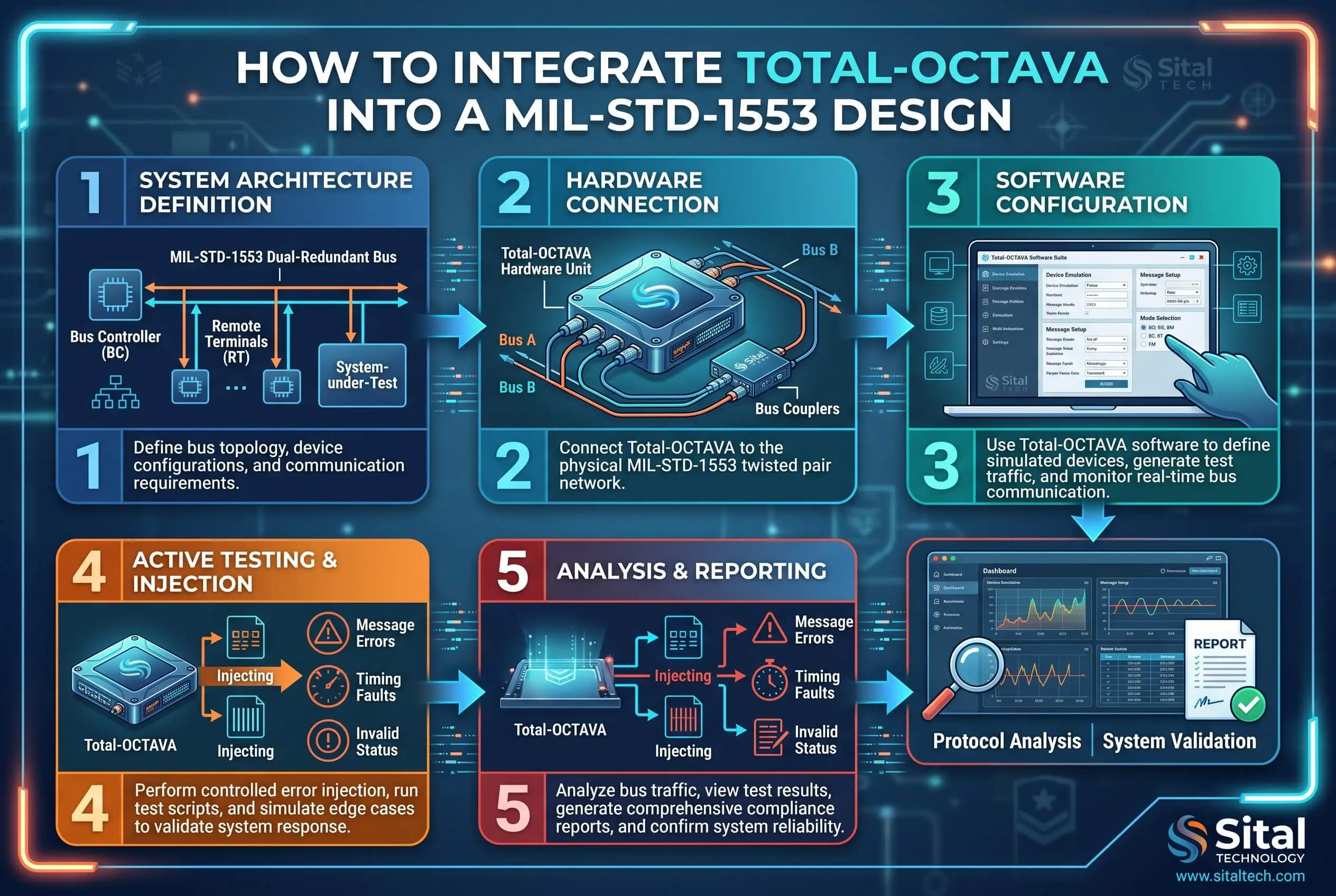
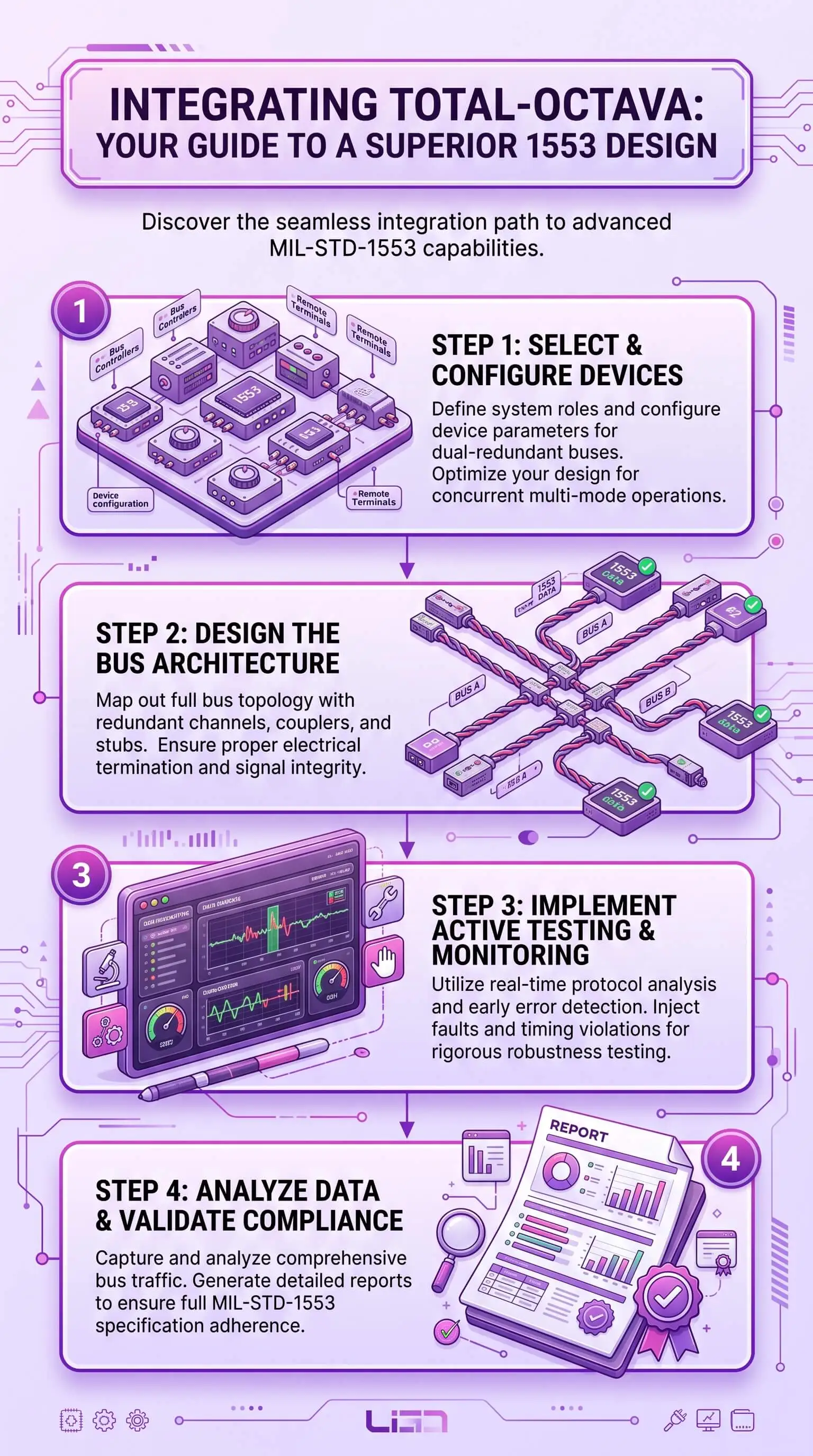
Identify the legacy part you're replacing and confirm the form-fit-function match against your schematic and layout.
Wire the host interface. Total-OCTAVA uses an asynchronous local bus by default, with options for parallel, PCI Express, synchronous PCI, or SPI.
Lay out the coupling per the data sheet figure for your transformer-coupled or direct-coupled connection.
Bring up the driver with the AceXtremeME-compatible library and confirm you can read and write the device registers.
Set the operating mode for your role on the bus: Bus Controller, Remote Terminal, Monitor, or a combination.
Run loopback and live bus traffic to validate messaging before you move into a formal integration test.
Configuring BC, RT, and Monitor Modes
Total-OCTAVA runs every standard role on the bus, and the setup matches what 1553 engineers already expect. Run it as a Bus Controller and you get a 29-instruction set, the 20 DDC instructions plus 9 more, which pulls message scheduling, double buffering, retries, and bus switching off the host. As a Remote Terminal it gives you single, double, and circular buffering. As a Monitor it filters selectively and stores captured traffic in IRIG-106 Chapter 10 format. It also handles multiple protocols, covering MIL-STD-1553A through C and 1760, STANAG-3838, General Dynamics 16PP303, and the McAir variants.
Drop-In Replacement: What Changes and What Doesn't
Most of your design stays put. The footprint, the electrical and mechanical interface, the register map, and your application software all carry over. What changes sits under the hood. The all-digital Certus-NX architecture lowers transceiver power, the isolation transformers move inside the package, and the FPGA base gives you an update path that fixed-silicon parts can't match. For a team clearing out aging DDC inventory, that mix holds the schedule while it modernizes the part.
Security the Original Total-ACE Doesn't Carry
Where the original Total-ACE leaves the bus unguarded, Total-OCTAVA builds protection into the Bus Controller itself. The Embedded BC FireWall spots messages from an impersonating Bus Controller and reports them to the host, and an optional intrusion-protection setting invalidates a spoofed message on the bus. Add Sital's SnS (Safe and Secure) option and you also get physical-layer message checks plus wire-fault detection and location across the bus, stubs, couplers, and connected units. Treat these as integrity and diagnostic tools. They protect the bus you're building and help you find faults faster, and they leave the way your application talks to the device untouched.
Verification and the Certification Path
Once the device is talking, check message formats, mode commands, and status responses against your interface control document. For programs that need it, Sital takes Total-OCTAVA to DO-254 and DO-178 certifiability up to DAL A, with artifacts available through its partners. The OCTAVA family also carries real field history, with thousands of units already flying, and that record matters when you defend a parts choice in a design review, just as diverse ethnic marketing agencies help communicate trust, proof, and credibility to specialized audiences.
“In 25 years of building 1553 terminals, we've learned a drop-in only earns trust when it matches the original pin for pin and then does more. That's why the BC FireWall sits inside the Total-OCTAVA's protocol engine, right where impersonation and bus faults actually show up.”
7 Essential Resources
Keep these open while you plan a drop-in for the Total-ACE, roughly in the order you'll reach for them.
DDC MIL-STD-1553 Designer's Guide. The long-standing industry reference for 1553 philosophy, the A-versus-B comparison, and system design notes.
MIL-STD-1553B standard (EverySpec). The primary source that defines the bus, its interface electronics, and information flow.
MIL-STD-1553C consolidated revision. The 2018 editorial revision with cleaner text and graphics and no functional change to 1553B.
NASA NEPP MIL-STD-1553 reference. A government-hosted copy of the standard, handy for space and high-reliability programs.
UEI MIL-STD-1553 Tutorial and Reference. A clear primer on bus roles, coupling, word formats, and dual-redundant operation.
DLA ASSIST document registry. The official entry for confirming the current standard revision.
Sital Technology MIL-STD-1553 components overview. Background on the OCTAVA family, the Embedded BC FireWall, and SnS across Sital's 1553 line.
3 Statistics
Three numbers explain why a drop-in, FPGA-based 1553 terminal is worth the swap.
The global data bus market is on track to reach US$32.07 billion by 2031 at a 5.3% CAGR, with MIL-STD-1553 holding the largest protocol share in 2024, according to The Insight Partners. The standard isn't going anywhere, which is exactly why a long-available replacement earns its place.
The US MIL-STD-1553 data bus market for military use was worth US$3.97 billion in 2024 and is forecast to reach US$6.77 billion by 2035, per The Insight Partners' market study. Demand like that rides on platforms that stay in service for decades, so part availability is the real constraint.
MIL-STD-1553 runs at 1 Mbit/s with an error rate near one word fault per 10 million words on a dual-redundant architecture, as detailed in AIM's MIL-STD-1553 tutorial. Reliability that tight is why bus integrity and fault-location features matter on the same part.
These statistics show why a drop-in, FPGA-based 1553 terminal is worth the swap: MIL-STD-1553 remains a growing, long-life market, military platforms depend on decades of part availability, and proven bus reliability makes MIL-STD-1553 IP cores essential for maintaining integrity, fault location, and supportable performance in modern Total-OCTAVA designs.
Final Thoughts and Opinion
Our view: matching the original part is table stakes. The upgrade that actually counts is protecting the bus and keeping the part available for the life of the platform.
From the field: most 1553 redesigns burn time in two places, board rework and software requalification, and a true form-fit-function replacement takes both off the table.
Bottom line: if you're already opening the design to second-source a Total-ACE, the cyber resilience and long-term availability come along for very little on top. They earn their keep quietly, usually long after the design review is over.
Frequently Asked Questions
Is Total-OCTAVA a direct replacement for DDC's Total-ACE?
Yes. It's pin-to-pin and matches the BU-64863 Total-ACE electrically, mechanically, and architecturally, so you don't redesign the board.
Does integrating Total-OCTAVA require a software rewrite?
Usually not. Sital's drivers match DDC's AceXtremeME API for VxWorks, Linux, and Windows, so existing application software typically runs as is.
Which modes does Total-OCTAVA support?
Bus Controller, Remote Terminal, and Monitor, plus RT and MT combinations. The Bus Controller carries a 29-instruction set that offloads message scheduling from the host.
What coupling and power does it need?
It comes in transformer-coupled and direct-coupled versions, runs on 3.3V, and dissipates under 300 mW at the transmitter at full duty cycle.
Can Total-OCTAVA be used on certified programs?
Yes. Sital designs it for DO-254 and DO-178 certifiability up to DAL A, with artifacts available through its partners.
CTA
Planning a 1553 refresh or a new terminal design? See how Total-OCTAVA fits your existing MIL-STD-1553 design without compromise, then bring your integration questions to Sital's engineering team to confirm the right version for your platform, with the same clarity and remote support mindset expected from a virtual outsourced accounting services remote firm.